


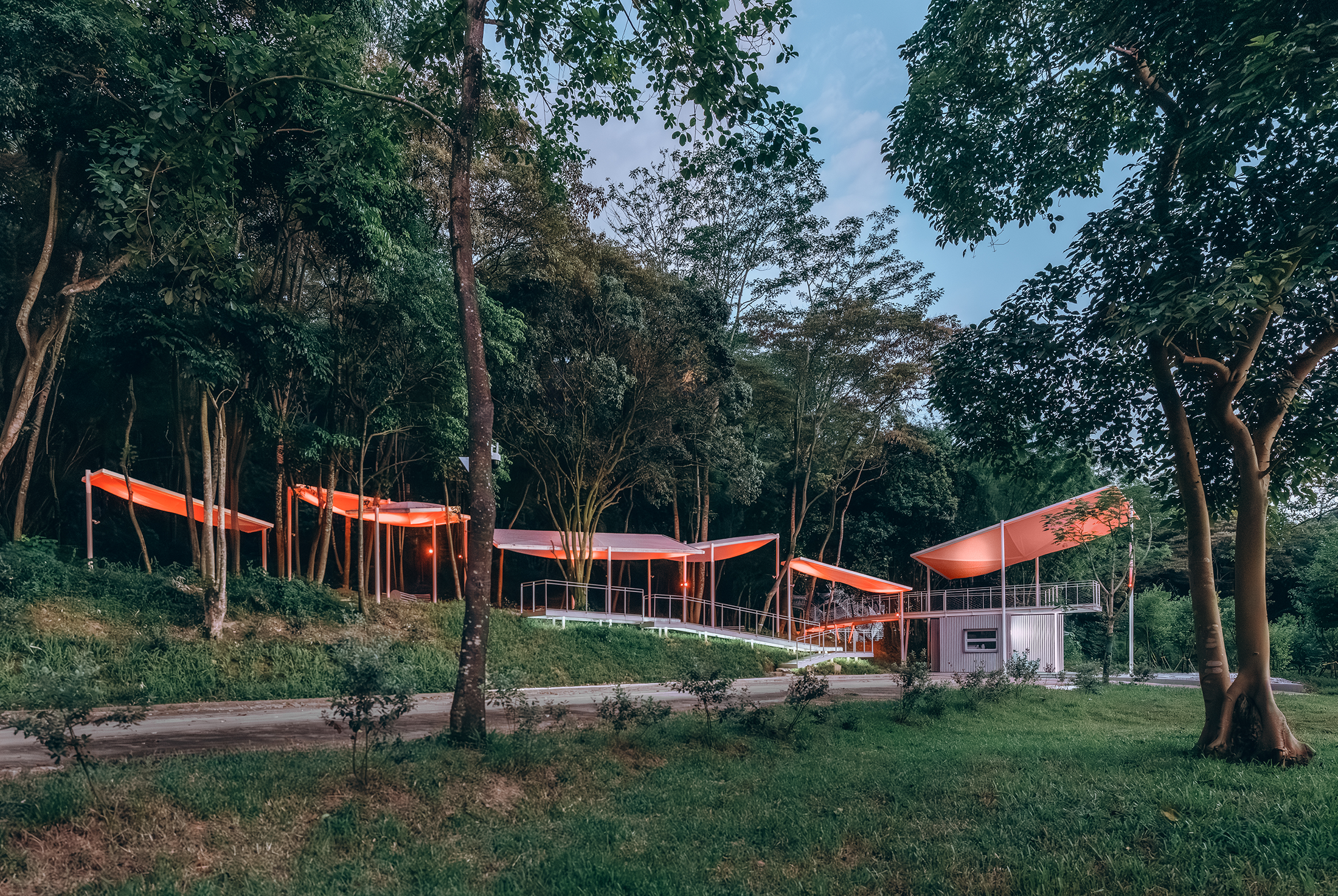
A rest stop for bicyclists with café and floating canopies within native woodlands – blending architecture, art, and ecology. Floating Canopy Grove is an architectural intervention in the forest – an ensemble of small public structures that bring together architecture, art, and nature to create a place of pause and reflection for bicyclists. Tucked within the dense woods beside Guoqian Village, near Xiangang Reservoir at Luofu Mountain in Huizhou, China, the project replaces two outdated public restrooms.
In response to the growing needs of bicyclists, the site has been reimagined as a woodland rest station, offering a small café, restroom facilities, and space to recharge. The grove is defined by seven translucent canopies that appear to float gently among the trees. Made of PTFE/Ferrari membrane stretched over steel frames, the canopies are suspended at varying heights and angles, forming a lightweight, artificial layer above the forest floor. They offer shelter while echoing the layered rhythms of the surrounding forest, creating a shifting experience of light, shade, and space. A steel-grated boardwalk weaves through the trees and beneath the canopies, connecting the café and restroom areas. At its end, a viewing platform opens onto sweeping views of the reservoir, extending the experience beyond utility into immersion in the natural landscape.



Details
Architecture
People’s Architecture Office; Zang Feng, He Zhe, James Shen, Liu Zhuo, Luo Qinming, Lin Mingkai, Huang Jia, Yang Quanyue, Yuan Yingzi, Cao Yuxuan, Wang Zihan
Client
Shanghai Fengyuzhu Exhibition CO., Ltd
Year of completion
2025
Location
Huizhou, China
Total area
36 m2
Site area
180 m2
Photos
Zhu Yumeng
Partners
Collaborating Artist: XU Ziwei
Powered by