

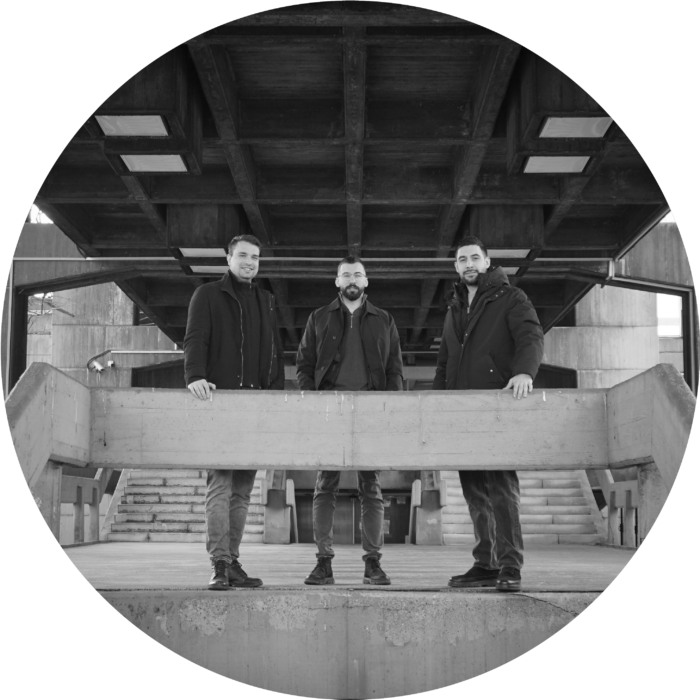
Uroš Majstorović, Dušan Grujović and Dušan Međedović, Serbia, 2026

Nominator: Branislav Mitrović
Nominator's statement
I am pleased to nominate a team of young architects: Uroš Majstorović, Dušan Grujović and Dušan Međedović. In their work, I noted: a good and exhaustive architectural analysis and relationship to the function of the object, a quality contribution in shaping the architectural form, a radical, responsible and high-quality urban setting. Their work is characterized by a well-cultivated, good and sensitive artistic contribution to the articulation of the architectural form. Through work on competitions, and already by participating in the preparation of technical documentation, and through experience through construction practice, they show a high degree of readiness: constant and safe progress in the profession.
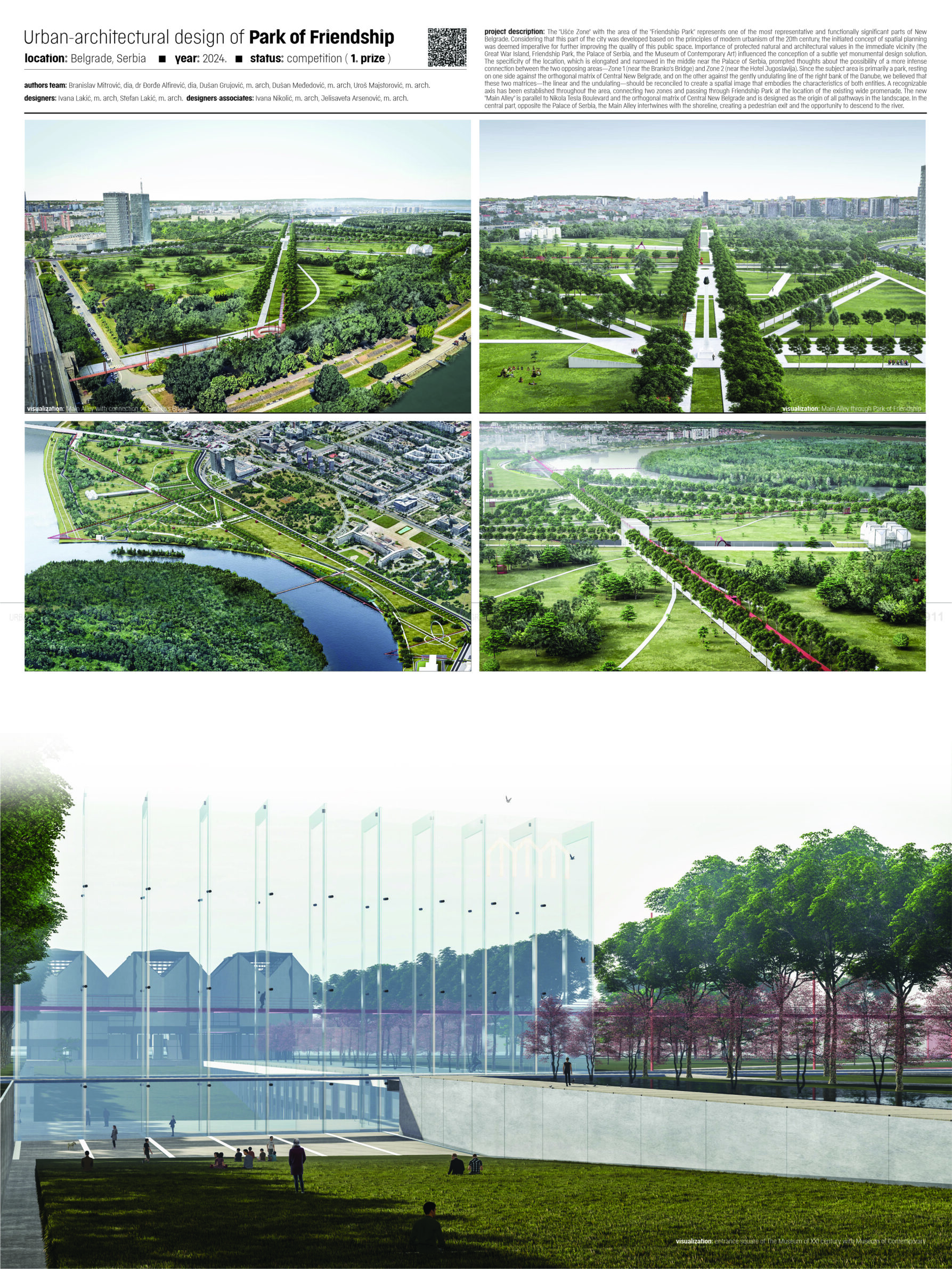
URBAN-ARCHITECTURAL DESIGN OF PARK OF FRIENDSHIP AND PRELIMINARY DESIGN OF MUSEUM OF NATURAL HISTORY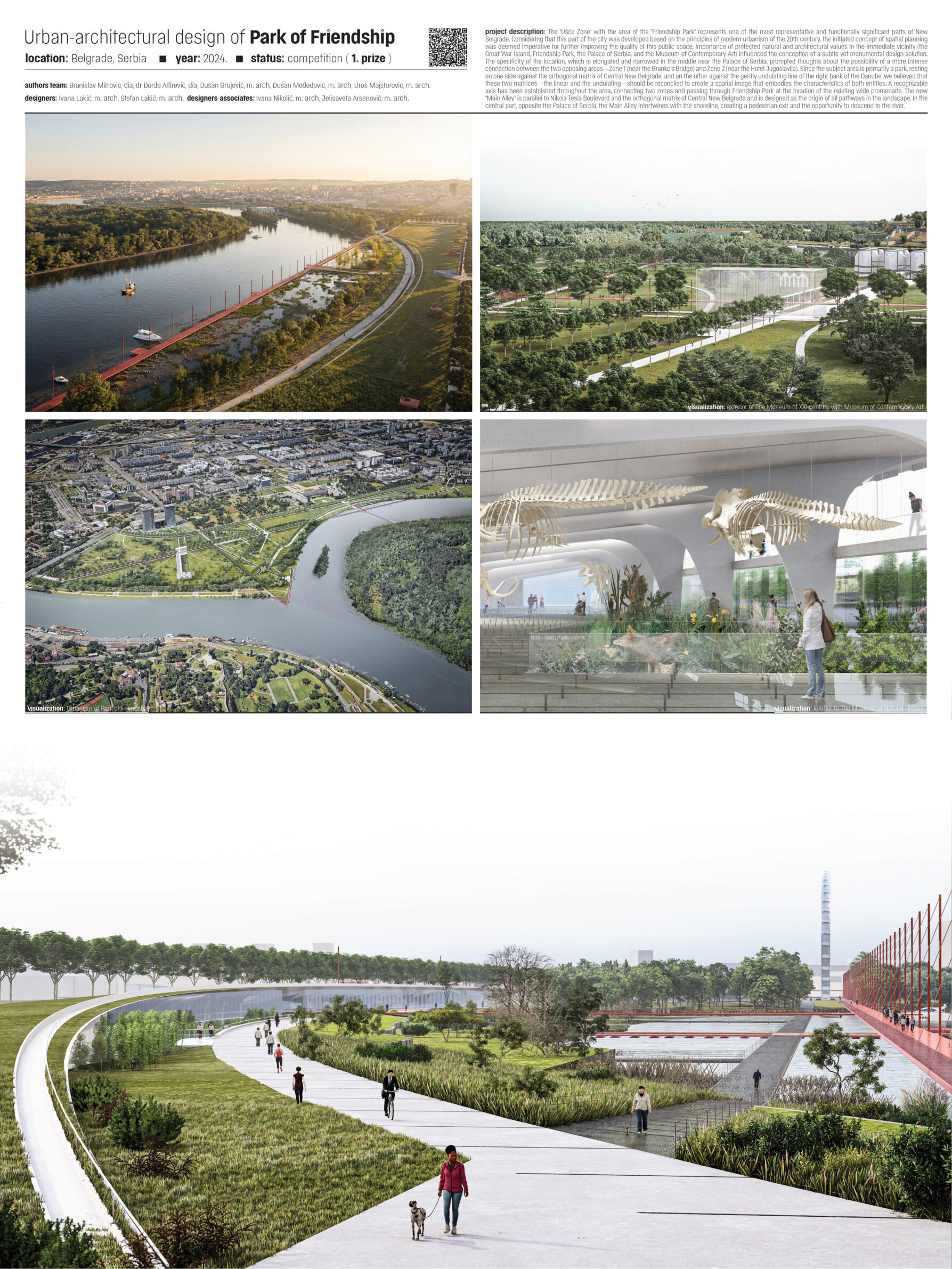
The Ušće area with the "Park of Friendship" area is one of the most representative and functionally significant parts of New Belgrade. Bearing in mind that this part of the city was created according
to the principles of modern urban planning of the 20th century, the spatial planning concept that was started was considered imperative in further improving the quality of this public space. The proximity and importance of protected natural and architectural values influenced the conception of unobtrusive, yet monumental creativity in the solution. The specificity of the location, which is very elongated and thinned in the middle near the Palace of Serbia, encouraged thinking about a more intensive connection of two opposite areas - Zone 1 (near Branko Bridge) and Zone 2 (near Hotel Jugoslavija).
As the area in question is mostly a park area, on the one hand directly supported by the orthogonal matrix of the Central Zone of New Belgrade, and on the other hand by the slightly undulating line of the right
bank of the Danube, we considered that these two matrices - straight and wavy - should be reconciled and form a spatial image that will have the characteristics of both units. A monumental axis connecting Zone 1 with Zone 2 and passing through the Park of Friendship on the site of the existing wide promenade has been installed throughout the area. The new "Main Alley" is parallel to Nikola Tesla Boulevard and the orthogonal matrix of the Central Zone of New Belgrade and is designed as the origin of all directions on the ground floor. In the central part, opposite the Palace of Serbia, the Main Alley intertwines with the coast line, forming a pedestrian exit and the possibility of going down to the river. The positions of all the
planned facilities (Natural History Museum, Museum of Contemporary Art, Aquarium) are directly connected to the Main Alley, thus creating a well-thought-out system of spatial experiences that are continuously connected.
The natural history museum is planned in the narrowest zone of the area in question, across from the Palace of Serbia and directly adjacent to the Main Alley on its south-western side. The decision for this position of the museum resulted from the desire to visually integrate the building with the most natural part of the Great War Island, and on the other hand to minimally affect the existing greenery, which is very thinned out in this area. The Museum of 21st Century Art is planned in the contact zone between the Museum of Contemporary Art and Main Alley, on its northeast side. The building of the new museum is designed as an elongated rectangular structure, buried in the ground, with the main approach from the position of the alley and a direct underground connection to the Museum of Contemporary Art. The lighting of the new museum is planned through a "water mirror" - a glazed roof lantern, over which a thin layer of water is covered, in which the building of the Museum of Contemporary Art is reflected from the position of the main entrance. The position of the aquarium adjoins the building of the Natural History Museum, on its north-western side, with which it forms a complete panorama as seen from the Danube bank.
URBANISTIC-ARCHITECTURAL DESIGN OF THE CITY OF BUDVA PROMENADE
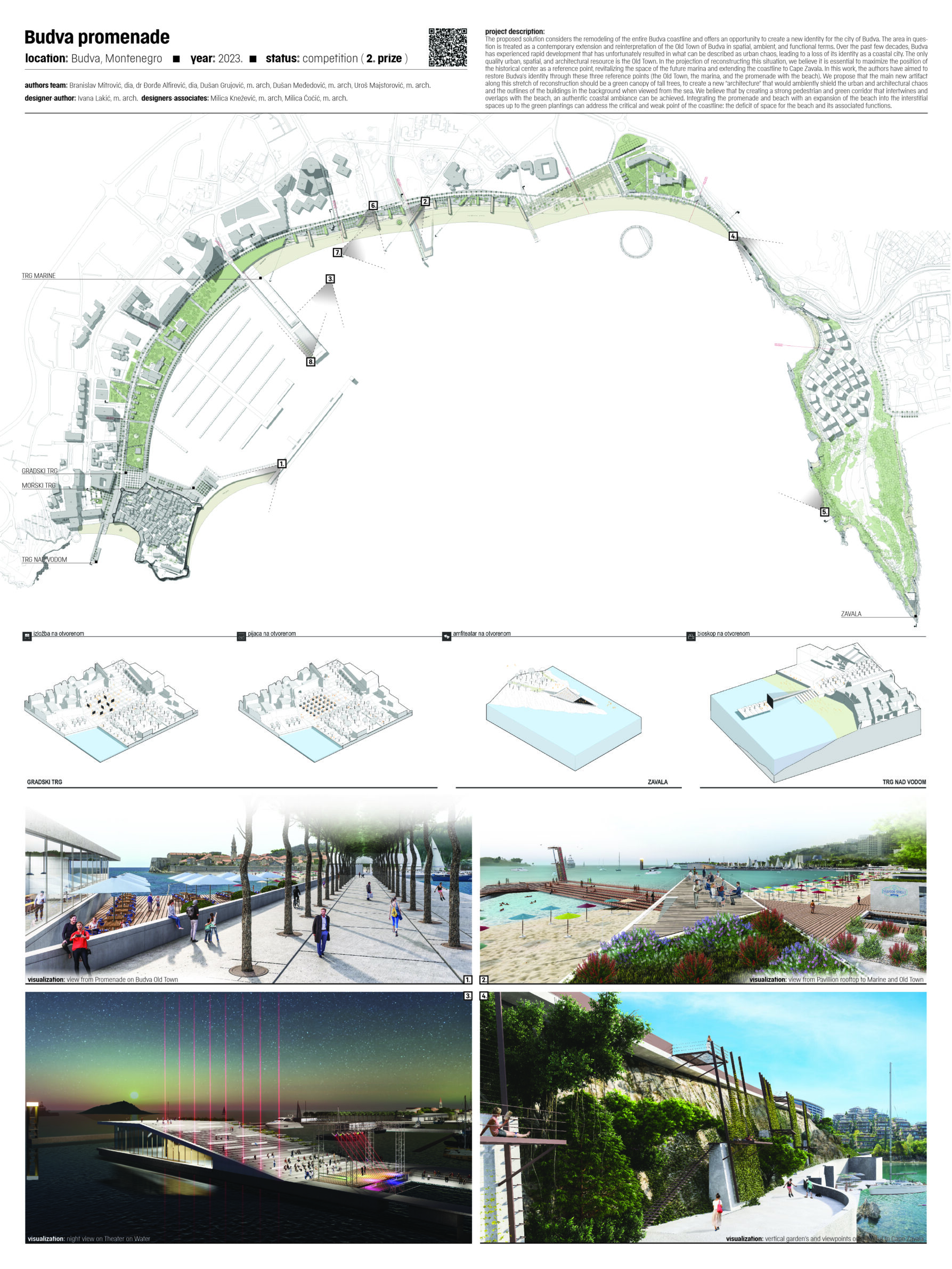
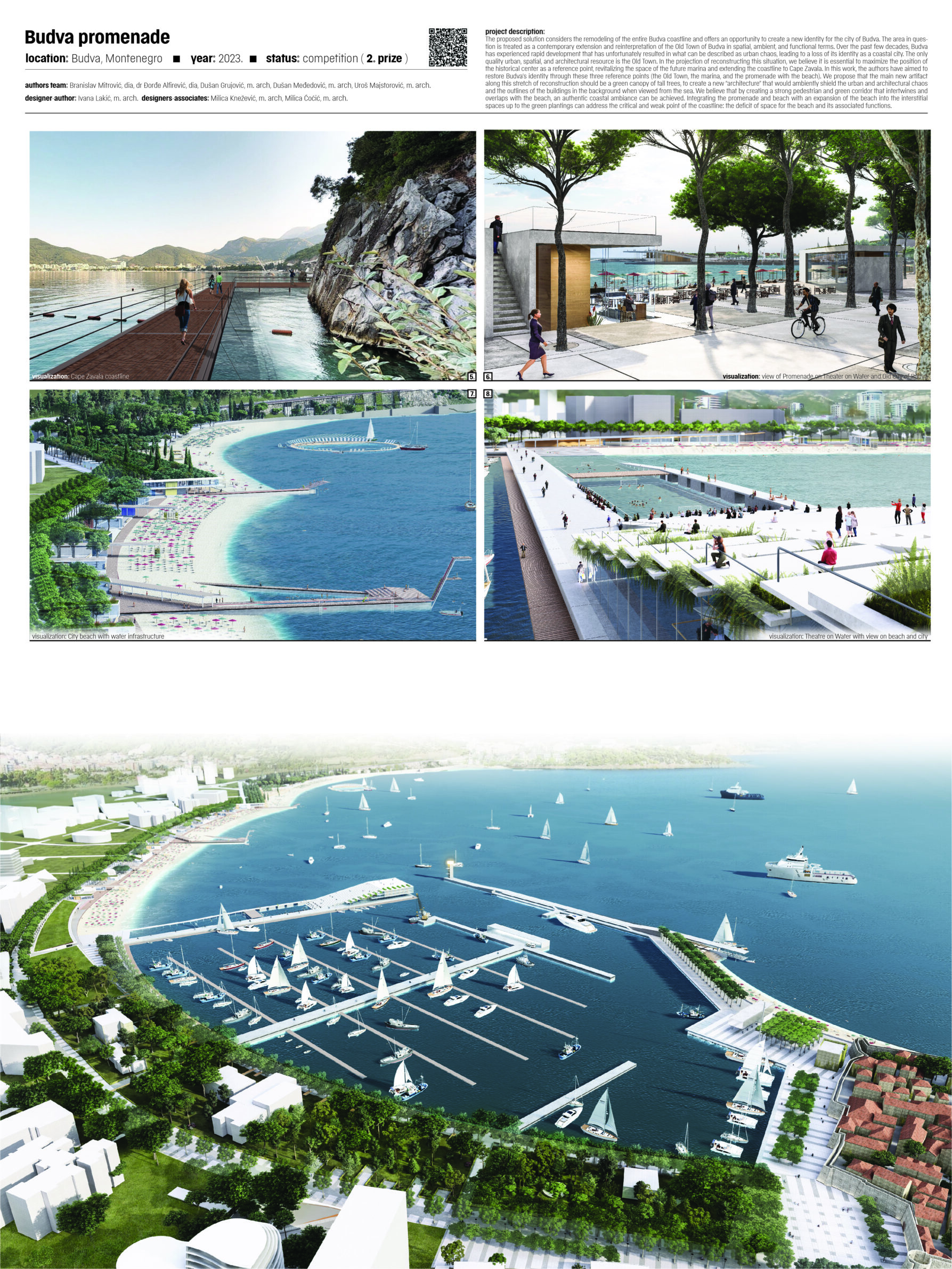 The proposed solution considers the remodeling of the entire coastline of Budva and provides an opportunity to create a new identity for the city. The subject area is treated as a modern extension and reinterpretation of the Old Town of Budva in spatial, environmental, and functional terms. In the last few decades, Budva has experienced rapid development that has unfortunately resulted in what could be called urban chaos, causing the city to lose its identity as a coastal town. The only high-quality urban, spatial, and architectural resource is the Old Town. In the reconstruction projection of such a state, it is believed that the position of the historic center should be maximally emphasized as a reference point, revitalizing the future marina area and the coastal area up to Cape Zavala. In this project, the authors have attempted to restore Budva's identity through these three reference points (Old Town, marina, promenade with the beach). They believe that the main new artifact along this route should be a green canopy of tall trees (native species of coastal pine, Lebanese cedar, plane tree, combined with mimosa, oleander, magnolia, olive, etc.), aiming to create a new "architecture" that would ambientally and visually shield the urban and architectural disorder and the contours of building structures in the hinterland when viewed from the sea towards the land. They believe that by creating such a "strong" pedestrian and green corridor, intertwining and overlapping with the beach, an authentic coastal ambiance can be achieved. By blending the promenade and the beach with the expansion of the beach into the intermediate space, all the way to the green plantations, the critical and weak point of the coast can be addressed - the lack of space for the beach and its associated functions.
BIO4 CAMPUS
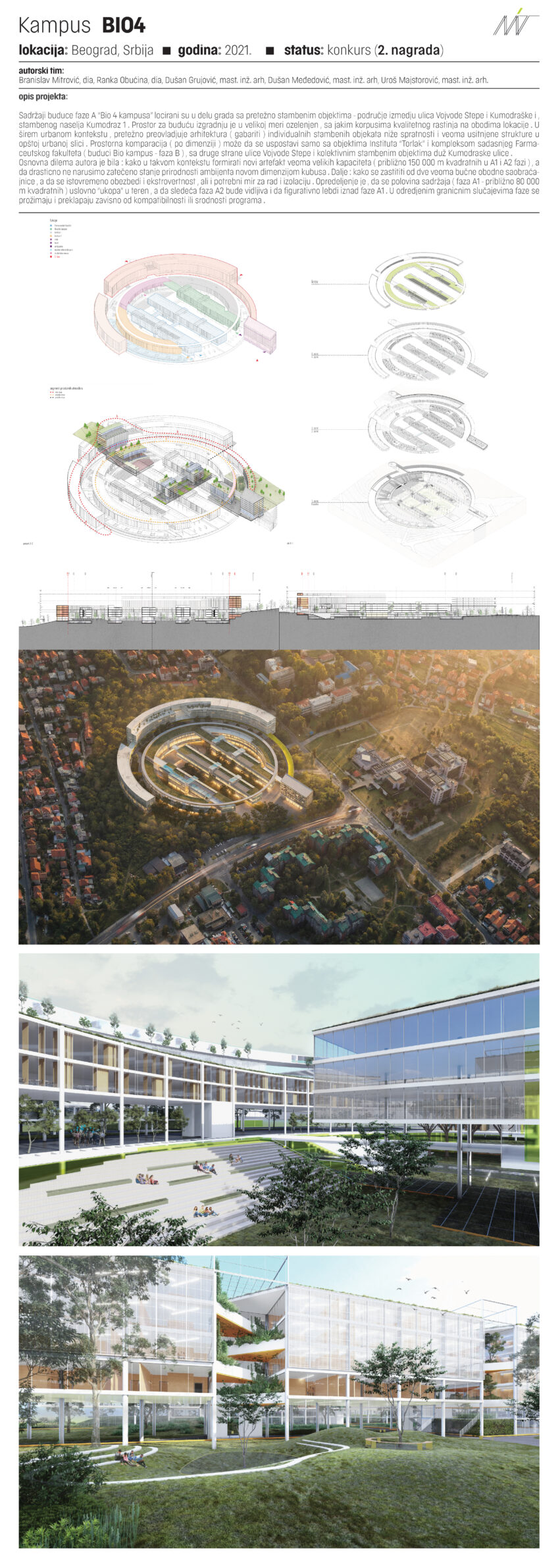
The contents of the future phase A "Bio 4 campus" are located in a part of the city with predominantly residential buildings - the area between Vojvode Stepe and Kumodraška streets and the residential area Kumodraž 1. The area for future construction is largely greened, with strong bodies of quality vegetation on the edges locations. In the wider urban context, the architecture (dimensions) of individual residential buildings with lower floors and very fragmented structures in the general urban image predominates. Spatial comparison (in terms of dimensions) can only be established with the facilities of the "Torlak" Institute and the complex of the current Faculty of Pharmacy (future Bio campus-phase B), on the other side of Vojvode Stepa Street and collective residential buildings along Kumodraška Street.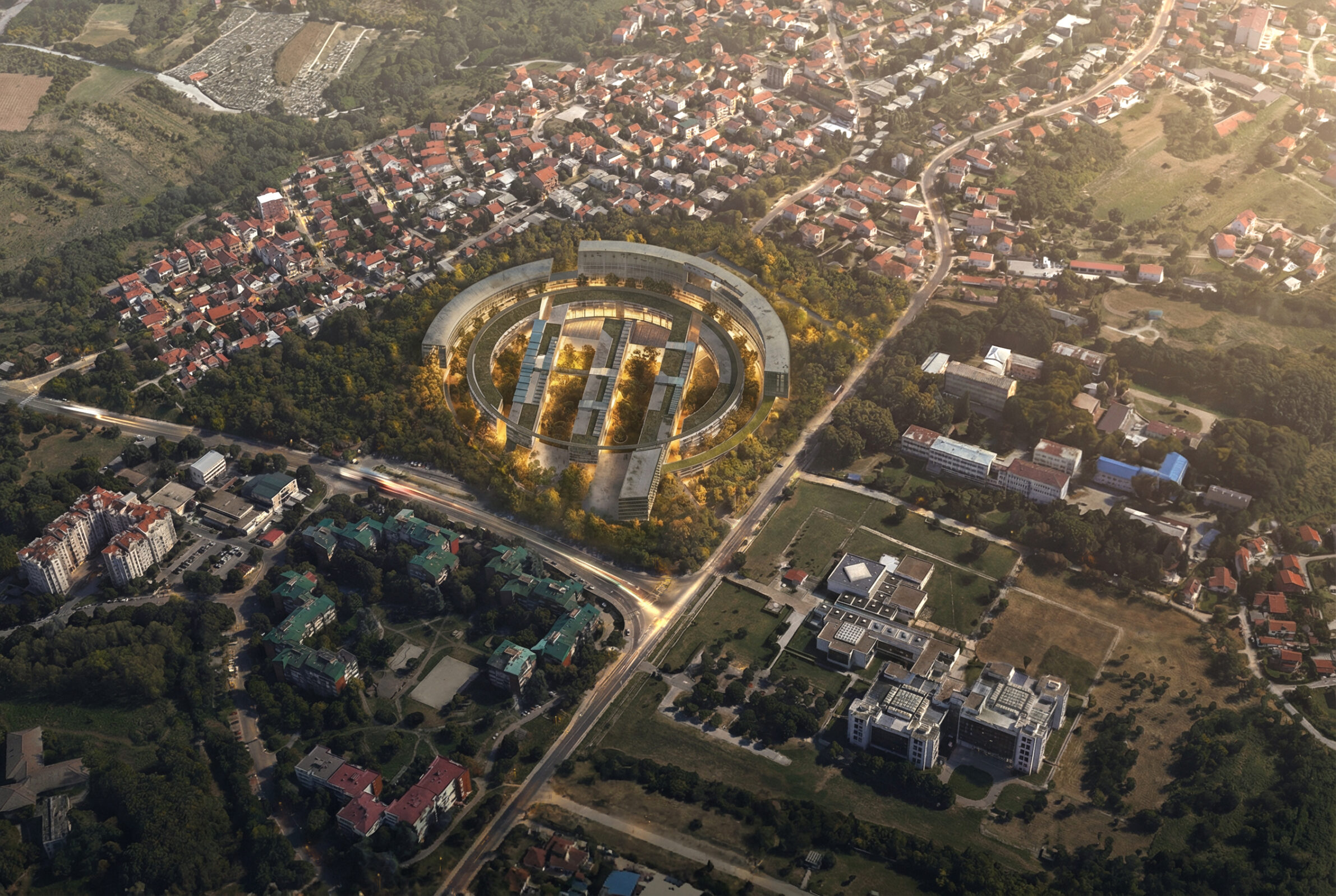
The main dilemma of the author was: how to form a new artefact of very large capacity in such a context (approximately 150,000 square meters in the A1 and A2 phase) without drastically disrupting the natural state of the environment with a new dimension of the cube. Further: how to protect yourself from two very noisy ring roads, while at the same time ensuring extroversion, but also the necessary peace for work and isolation. The decision is that half of the content (phase A1 - approximately 80,000 square meters) will be conditionally "buried" in the ground, and that the next phase A2 will be visible and figuratively float above phase A1. The choice of the circle as the basic - primary form is for the reason that in this way we "free" the precious edge formations of greenery at our location. Also, transparency and the impression of togetherness are achieved in the occupied space, and at the same time the isolation required for this form
of work and research. Within the circular form, bodies of buildings are formed that extend longitudinally, and interweave and connect in the transverse direction in the form of footbridges or bridges, as well as vertical communication nodes. This could be called an internal communication nervure between or within objects. Between the peripheral (circular) wreath and the directions-axis of the space established within it, the isolation of the working parts is ensured, but at the same time the permeation of related contents. In the basic image of the object, the geometry of the circle is "decomposed" by green penetrations, on the roof and in the ground floor, creating the illusion or impression of interweaving (built) and natural.
In other words: bodies of greenery alternately permeate the circular form.
In the intersections of the geometry of the circle and orthogonal directions, "green buffers - wells" are realized as a spatial and visual interruption, or a place of rest, meeting, communication... The entire surface of the circular plateau at an elevation of -2 in relation to the access level is organized as a garden, greenery, small forums for debates or gatherings - communication.
The form of the circle gathers and summarizes in itself, but in such scientific complexes where the way of working is rapidly changing and knowledge is improved, the need for new content is imperative. Such a need will be able to be realized in the future because the circle as a primary form allows permeation and development outside of its basic form. With that, the idea was imposed that by "immersing" the new built structure into the terrain, the visible dimension of the new artifact would be reduced, and thus the visible part of the new form would be emphasized in its uniqueness. The space organized in this way is protected from the bustle of the street, cars and external noise in general, as well as natural influences such as winds or summer heat - a pleasant micro-ambiance with maximum control of external influences has been created, which can be treated as sustainable. The direction of the basic provision of objects within the circle: north - south, ensures orientation and protection from the sun.
UROŠ MAJSTOROVIĆ, DUŠAN GRUJOVIĆ AND DUŠAN MEĐEDOVIĆ
Dušan Grujović and Dušan Međedović from Požega and Uroš Majstorović from Užice are architects who completed their Master’s studies at the Faculty of Architecture in 2020. Following graduation, they began their professional practice at the architectural studio MITarh, where they further developed their architectural and design competencies.
Their work gained early recognition through architectural competitions and the realization of significant projects. They are authors of more than 20 architectural competition entries, earning 2 first prizes, 3 second prizes, 2 third prizes and 2 honorable mentions.
Among their most notable achievements are the first prizes for the Depot of National Library of Serbia in Belgrade and the Natural History Museum and Ušće Park in Belgrade, projects of major public and cultural relevance.
In addition to competition work, they are authors of projects currently under construction, including an information pavilion in front of the Old Town in Užice and the “Miloš Crnjanski” Primary School in Novi Sad, demonstrating their ability to consistently translate conceptual ideas into built form.
Their work has been presented at numerous national and international exhibitions, including the Salon of Architecture, Salon of Urbanism, STRAND, and the Balkan Architectural Biennale, where they were awarded the Second Prize.
Contact
majstorovic.uros96@gmail.com,
grujovic.dusan96@gmail.com,
duuuu.san96@gmail.com
Powered by

Be There.