


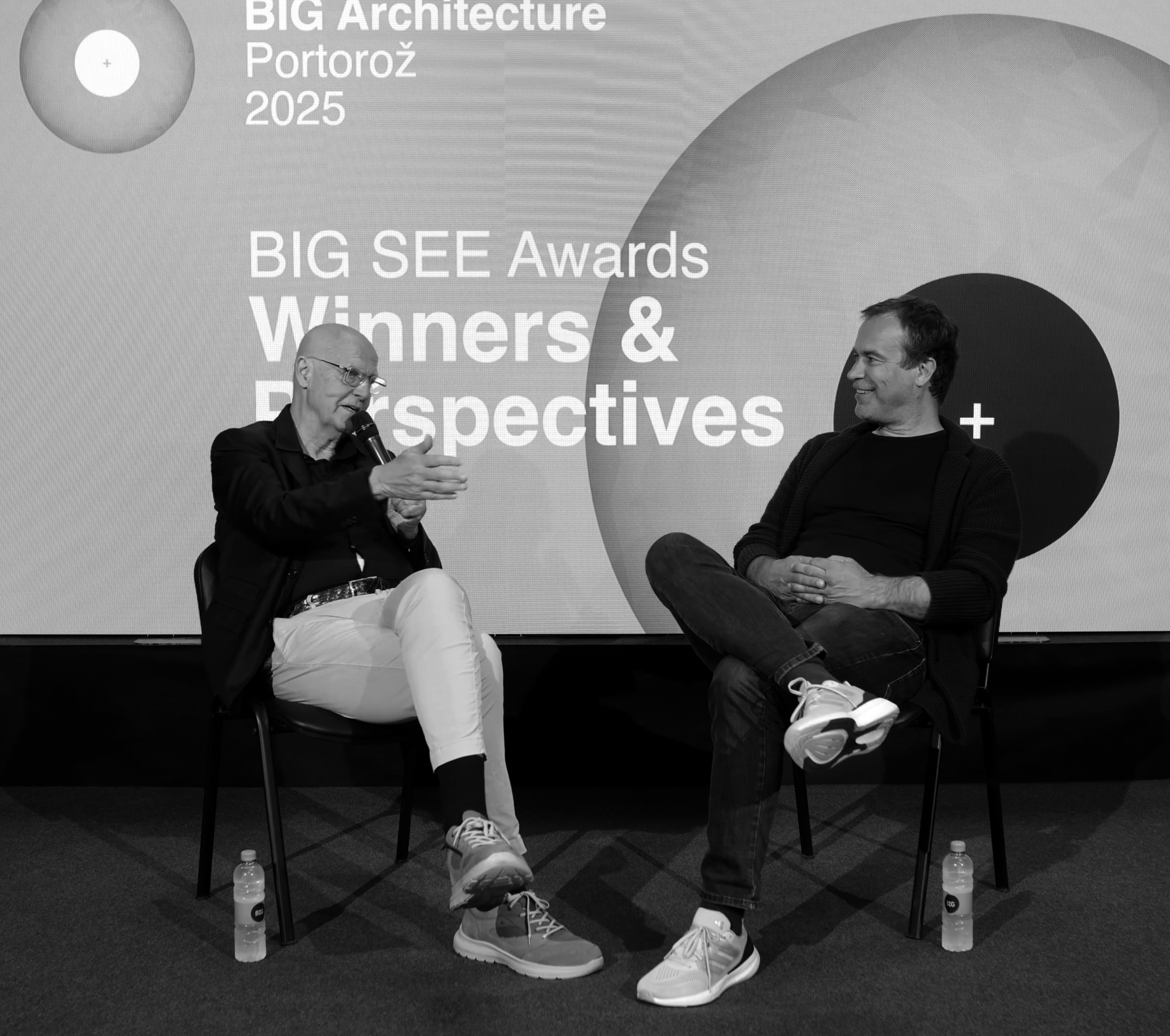
In May 2025 Portorož hosted the two day BIG Architecture event, a meeting point for architects from across the region and beyond. Somewhere between award ceremonies, coffee breaks and tight schedules, we quickly put together this conversation on one of the winners’ stages.
On one side sits Peter Gabrijelčič, professor at the Faculty of Architecture and partner at ARHITEKTURA d.o.o. On the other is Marko Dabrović, co founder of 3LHD in Zagreb, the studio behind the Rimac Campus Production Facility, Grand Park Hotel Rovinj and Hotel Lone Rovinj. They talk about why architecture must stay a serious profession, what the Biennale in Venice is missing, how public space shapes our lives and why doing “nothing” can be the most productive moment of all.
Take a moment to join their conversation, either by watching the video or reading the transcript.
Peter Gabrijelčič: Like we usually say, it is a big pleasure to be here with the famous architect Marko Dabrović, who is part of the 3LHD company, which is for Slovenians some kind of lighthouse, a point of orientation for what architecture used to be or what it should be in the future.
I heard his lecture discussion in a big hall one hour ago, and I remember that he said architecture is a serious profession. I totally agree with that, and I would like to start with one of my observations about the Biennale in Venice this year. I was there two weeks ago and I was very disappointed. Why? Because they started six years ago with a debate about sustainability, eco architecture, climate change and so on, about the necessity that the profession should be more inter or trans disciplinary and so on.
But I expect that after six years there should be one step further, that something should be happening on an architectural level, in production. I tried to discuss this fact with my colleagues in Slovenia and they said, “Oh, it is not my topic,” or, “You know, it is a political question.” So I started to discuss it with the GPT chat and I asked him, “What do you think I am missing in their architecture?” Because the starting point is usually, and it has to be, a naive token debate.
After six years there should be some implementation, some way to spread that knowledge on an architectural level for people all around the world, to make some good things from it. GPT also said, “Okay, but you know, this exhibition is not in such a format.” I said, “Yes, but it is architecture.” He said, “Yes, but you have many different possibilities, Miss Van der Waals and so on. This is more for some kind of research debate and so on.” I said, “But after all, there has to be something further.”
He replied, “Yes, but you know, this is very difficult. You need a lot of effort. You need money. You have troublesome bureaucracy with, I do not know, politics and so on.” I said, “Yes, but even in architecture we have the same problems, but we have the courage to fight for a result.” In the end he disagreed and agreed at the same time, he agreed with me, the system agreed, not the person.
He said, “Yes, maybe it is very comfortable to be all the time, for 60 years, in the first position of the avant garde and to do nothing, because you have the excuse that it is difficult.” And now, for us, I agree with you that architecture is a serious profession. What I admire in your office is that you started with such discussions 20 years ago. You made all your projects interdisciplinary, with sociologists and philosophers, you involved the public in debate, you used many new technologies, and every project of yours, which I admire very much, is in some way a fight and a step ahead. What do you think?
Marko Dabrović: Thank you for this great admiration, of which I am really proud. But you know, they say the grass is always greener on the other side. I think this also applies to Slovenia and other countries; they always seem better than the place where I live.
We founded this company because of architecture, not because of business or anything else. Everything we did in our career, we were four students who started 30 years ago, was about the project. When we have a new project, we are looking for who is the best team to make it happen, even if it is not an architect but a graphic designer or structural engineer or whoever. We are looking for the team, because the goal is the project, to realize the project.
This is why I think architecture is serious. It is not just a job, it is something more. When you approach architecture in this way, you enjoy it more. It is more difficult, but you can definitely sustain more energy in designing and looking for a solution. At the end you are not satisfied with the first result, so you have to look further. It is the same as when you ask your ChatGPT; you are not satisfied with the first answer, so you keep looking into it.
I think that as an architect, working in architecture which is so slow and sometimes takes more than seven years to build something, you need to sustain this curiosity and passion to make it happen and to pollinate all the people around you, from the client to everyone who works with you. Architecture is no longer a project of one single genius. It is more and more the work of huge teams, because it is becoming extremely complicated with new technologies and ever changing regulations. So I think the most important thing in architecture is to approach it as a serious endeavour and a mission, not for money, because the money is not really there.
“We founded this company because of architecture, not because of business or anything else. Everything we did in our career was about the project.”
– Marko Dabrović
Peter Gabrijelčič: About the Biennale, do you also think there should be projects that are actually built, as case studies, showing how to implement these new approaches now? Because that is really the missing link. The Biennale is now more like an art Biennale than an architectural one.
Marko Dabrović: I agree, it is really a Zeitgeist. Sometimes even I do not fully understand it. It seems that those who are close to the Biennale may have a mission that is different from what practising architects are looking for.
We, as practitioners, need real feedback: does it make sense, where do we go from here? The Biennale gives us tests, but not solutions. Maybe we should not look there for solutions; otherwise we will be disappointed, because there is no practical evidence or clear results about what happened in the last three Biennales or what we learned from them.
For example, when I took my daughter, who started studying architecture a few years ago, to the Biennale, things were a little different. There was a new project from the Saudi Arabian exposition in a former monastery near Santa Maria della Salute, where they showed “The Line” with all these star architects. It seems that the world is divided in two. The Arabs had the star architects, and the Biennale remained for those architects who did not have the chance to build real projects. Maybe that is just the Zeitgeist. There is something more than we can understand.
“I once listened to a lecture by Sir Norman Foster. He said, ‘I am only interested in public space; architecture is just the texture that forms it.’ For me, this applies to your projects as well.”
– Peter Gabrijelčič about Marko Dabrović’s projects
Peter Gabrijelčič: My colleague, the professor, says, “Today, beauty is forbidden for architects.” But in your architecture, what stands out is this constant care for the public interest and public space. I once listened to a lecture by Sir Norman Foster. He said, “I am only interested in public space; architecture is just the texture that forms it.” For me, this applies to your projects as well.
A few years ago, I took my students to Siena. Normally, architects sit and sketch so they can feel the space and the ambience, but now all the students just look at their mobile phones. Even young children are always connected to virtual space. When we went to Venice, they said, “It is like in a game.” For them, the game was reality. Then we started to talk with our students and got them drawing, and after a week they gradually adapted and started to feel the ambience.
Even in basketball, which is fast and sharp, there is a break; you need a pause to think about the next step. For young people and for us there should be places, “free areas,” where you are not pressured to compete or fight but just listen to the wind, see the sun and take a break, like in that basketball game. Otherwise, for whom are we designing spaces with feeling?
Marko Dabrović: Yes, in our projects we have always looked for public space, even within buildings. It is well known that you can create a wall so that a building remains private, but in some of our buildings we always try to find something public. For example, the roof of the sports hall in Rijeka, where you can walk on the roof, or the hotel in Rovinj, where anybody can walk through the lobby and feel that it is a covered public extension.
What you said about Venice also happens in Dubrovnik after Game of Thrones. People come and say, “Did you build this for the movie set?” Today’s kids have the internet as their reference. It is responsive and gives quick information. Yet building is still slow, communication is still slow; it has not changed since the beginning of the last century. That is why in our company we started developing software to connect people, because the amount of information is enormous.
Before, a sketch given to a construction company was enough for a miracle and there was no need for lengthy documentation. Now there are thousands of people at the construction site, so old technologies are not enough.
To get back to your question, I think we need public and private spaces with these gaps where you can sit and do nothing, really nothing. We call this “fiacre.” In Croatia, on the coast, it is the time when you are not even supposed to think. That is when the best ideas happen.
“Architecture is no longer a project of one single genius. It is more and more the work of huge teams, because it is becoming extremely complicated with new technologies and ever changing regulations.”
– Marko Dabrović
Peter Gabrijelčič: I appreciate very much your way of working. You are really still an architect with knowledge of technology, artificial intelligence, sociology, politics, economy and so on. But in the end you are producing good architecture. I remember that you are not a slave to so called tendencies. For you, every task is unique, a research, a way to nowhere, and that is really good.
I remember when I saw the Lone Hotel for the first time in a magazine. I thought, “What kind of form is this, it is a little bit kitschy, like Dubai or something.” But after I visited it, as a guest of your company, I realized it is a composition of different sequences and every sequence has a reason and a common will.
If I compare architecture in Slovenia and the architecture of that hotel, I think our offices, some of them really good, sometimes have a very rational concept but perfect execution in the details. When it is done so well, it becomes poetic. In your case you go one step further. Your ambiences are unique and volumetric, like in Lone. Such things do not happen in Slovenia, not because our architects cannot do it, but because we do not have such clients. It is not possible.
Marko Dabrović: It is very nice to hear everything from you, but I love Slovenian architecture. I love the attention to details and the quality of craftsmanship. I also think it is one of the top in Europe, almost like Swiss architecture. There is great knowledge, not only in architects, but also in construction companies and small manufacturers who know how to work with details.
As I said, our focus in designing these projects was always to make each one unique. In Rovinj, we did two hotels for the same client, maybe 300 meters apart, but with completely different concepts. When you design in a forest, where all sides are similar, there is no real focus and it becomes a bit banal. For Hotel Park the location is beautiful, overlooking the city, so what can you do? You decrease the architecture and give priority to the guest and their experience.
For Lone, wherever you go, even with difficult terrain, there is no back of house; it is always the same logic everywhere you walk. With Grand Park Hotel, the focus is the view, the beauty in front, so we had to change our way of thinking. The hotel itself cannot be drawn as an icon. With Lone, you can give a kid a pencil and they can draw it, but with Grand Park there is no icon, it is more urban design, like topography.
Maybe there are only five pines, more than one hundred years old, which we kept during construction. Sometimes people asked, “Wouldn’t it be easier to cut them?” No, the hotel is named Park and it keeps these five pines alive.
“There are five pines, more than one hundred years old, which we kept during construction. Sometimes people asked, “Wouldn’t it be easier to cut them?” No, the hotel is named Park and it keeps these five pines alive. .”
– Marko Dabrović about Grand Park Hotel Rovinj
Peter Gabrijelčič: You also showed how to design a factory, like Rimac. With such a huge programme, you should not just multiply small structures but create something on a higher level, and for me that is perfect.
Marko Dabrović: Yes, thank you again. We had no experience designing factories before, and neither did Rimac. They were a start up with only a prototype, a big dream and not much clarity about their direction. So we spent a lot of energy understanding the company behind the architecture and we found that they were proud of certain values: speed, growth, balance, family and openness.
Using these five values, we created not just a factory but a campus. For openness, the factory should be open, not closed, for employees. For balance, nature and the value around it should be preserved. There is an existing castle, so we kept the factory height lower than the castle. For family, we created a restaurant inviting not only factory staff but also outsiders, so people eat together and interact, breaking barriers.
We also thought about animals. There is land for sheep, so they live in harmony with hypercars, high technology and humans.
Peter Gabrijelčič: Yes, I have seen this in big German factories. They are like a small town, a family. It is a responsibility to the workers.
Marko Dabrović: Exactly. We should discuss more, but maybe we can continue over coffee. We have spent all our time in discussion here.
“With Grand Park Hotel, the focus is the view, the beauty in front, so we had to change our way of thinking. The hotel itself cannot be drawn as an icon. With Lone, you can give a kid a pencil and they can draw it, but with Grand Park there is no icon, it is more urban design, like topography. ”
– Marko Dabrović
Powered by

BIG SEE Talks is a series of intimate, unfiltered conversations between architects – not just about buildings, but about how we think, live, and imagine our future environments.
In this edition, architect Jurij Ličen speaks with Alper Derinboğaz, founder of the architecture studio Salon, which operates between Istanbul and New York. The conversation touches on architecture’s relationship to time, geology, digital tools, and the role of intuition in creative practice.
Watch their insightful conversation or dive into the full transcript.
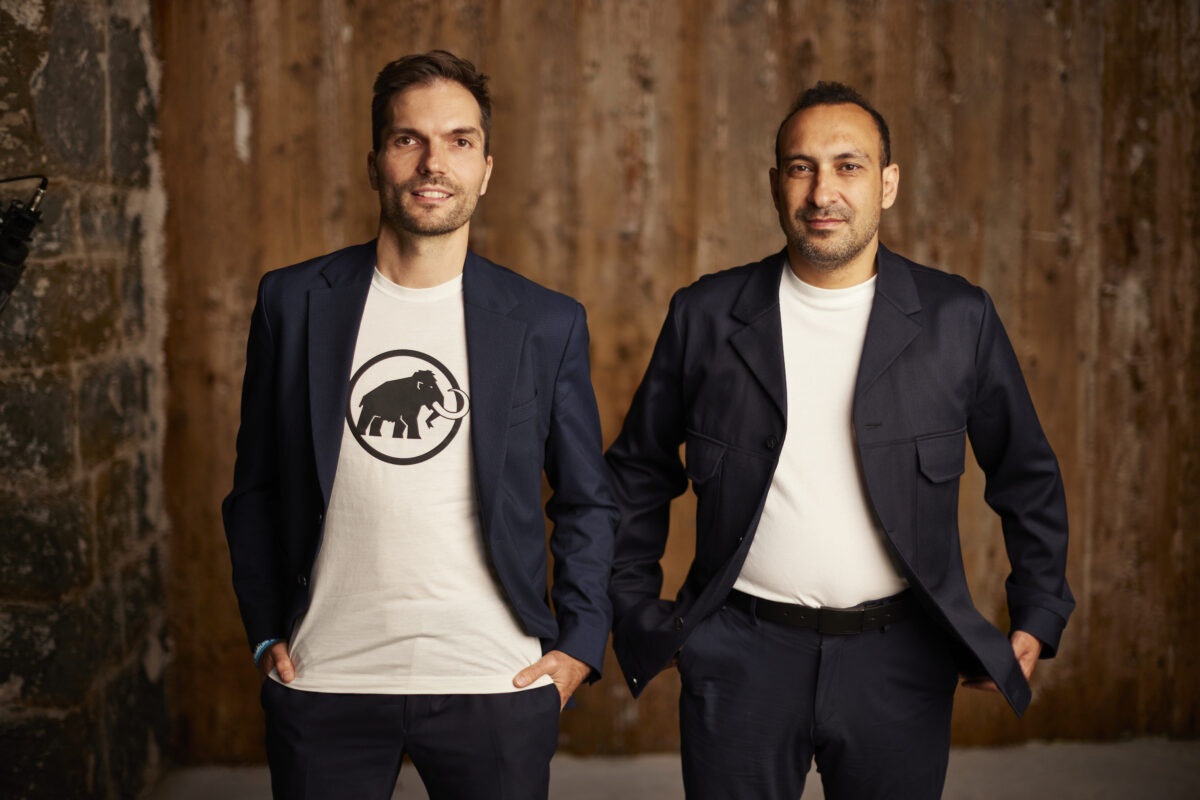
Jurij Ličen: We are joined by Alper Derinboğaz, who is the founder of the architecture office Salon, an internationally acclaimed office with offices based in Istanbul and New York. His work explores an interesting intersection between architecture, nature, geology, and technology, which he calls geo spaces. Beyond practice, he is also a prolific academic and educator with experience from UCLA and the Pratt Institute in the United States, where he contributes to research in computational design and digital fabrication. I’m curious about the origin of the name Salon for your architecture office.
Alper Derinboğaz: Like many things we do, the name carries two meanings. The first is a visible meaning, and in many languages, especially Turkish, it refers to the first public interface of your home – essentially the living room. But looking beyond that, in French history, it also refers to a place where revolutions begin through ideas, conversations, and exhibitions. We believe architecture should have motivations that extend beyond functional, practical uses. So perhaps the name reflects that.
Jurij Ličen: So in a sense, the name itself carries more weight than just being an architecture office – it also encodes a bit of a political agenda?
Alper Derinboğaz: Exactly. Architecture is such a large machine that moves many things and becomes part of society, often using significant resources. We can’t simply treat it as a functional artifact or object. The way we create buildings moves many pieces, so we always wanted to have an idea that goes beyond architectural value.
Jurij Ličen: Because you mentioned the French meaning of the word salon, where revolutions start through discussions in living rooms, do you think architects also have a revolutionary role? Should architects be the ones who bring out different, perhaps revolutionary, new, or controversial ideas?
Alper Derinboğaz: Definitely. We are trained to create new things, develop strategies, and make complex ideas happen. I see architecture as an incredibly vast resource in today’s society. Architects could be leading this transformation. I’m not saying we are, but there are many possibilities. Architects are particularly skilled at generating new ideas, strategies, and inspiring other practices and professions.
“Architecture is such a large machine that moves many things and becomes part of society, often using significant resources. /… / The way we create buildings moves many pieces, so we always wanted to have an idea that goes beyond architectural value.”
– Alper Derinboğaz
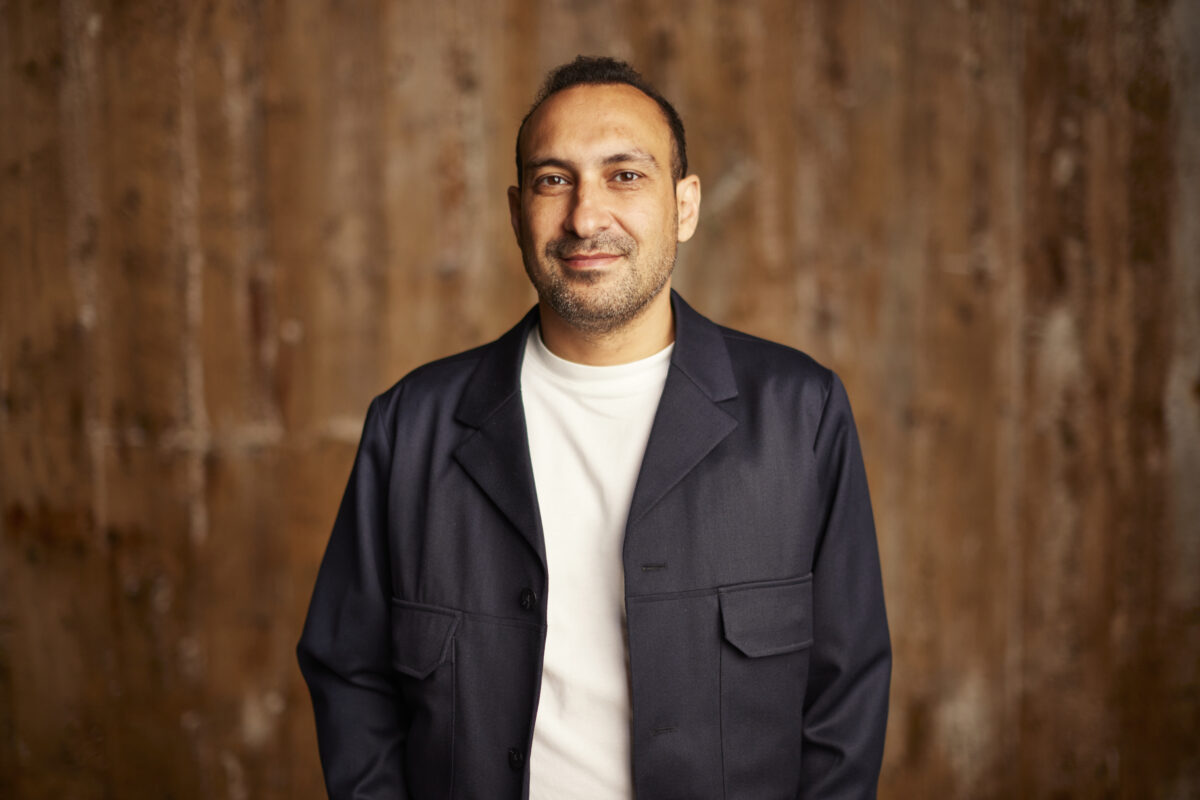
Jurij Ličen: Since you have a global practice working across different scales, countries, cultures, and environments, and you employ digital computational design technologies, algorithms, and digital fabrication – how do you balance these new tools with being contextual and embedded in a specific site? How do you respond to critical regionalism and avoid the homogeneity of global architecture?
Alper Derinboğaz: I think we are only seeing the first iteration of digital tools becoming part of architecture. The work of pioneers like Greg Lynn, Zaha Hadid, and Frank Gehry were extremely important, but these are just tiny experiments compared to what future generations might achieve. The greatest strength of digital architecture is its ability to be very specific. Beyond creating sculptural ideas, digital architecture allows us to integrate buildings into cities in a more nuanced way. Through these technologies, we can find continuities with nature. Currently, construction often involves clearing a site and importing materials from everywhere, which future generations might view as an incredibly inefficient approach. I don’t understand how architects can avoid technology. These tools are vastly underutilized, and they might be the only way to get things right. Through these techniques, we can relate to natural systems, existing resources, and environmental components much more wisely. I’m not saying we’re taking full advantage of these tools yet, but we’re still at an experimental stage.
Jurij Ličen: I think early digital experimentation, like with Greg Lynn and Zaha Hadid, was more about the excitement of creating geometries that were previously difficult to achieve. With digital fabrication and CNC machines, suddenly it became possible to fabricate complex computer-generated forms. Now, as Mario Carpo might say, we’re at the “third digital turn”, where it’s no longer about what we can make, but what we should use these tools for.
Alper Derinboğaz: Exactly. As architects, we might even choose not to do anything interesting, which can also be a strong position. We might not need a building. What we often underestimate in digital architecture is the ability to analyze the environment. Instead of simply placing an object on a surface, we can now understand what has existed underground for hundreds of years. We can investigate underground waterways, historical landscapes, and local biodiversity. I believe we’re not fully understanding the research capacity of this technology.
“As architects, we might even choose not to do anything interesting, which can also be a strong position. We might not need a building.”
– Alper Derinboğaz
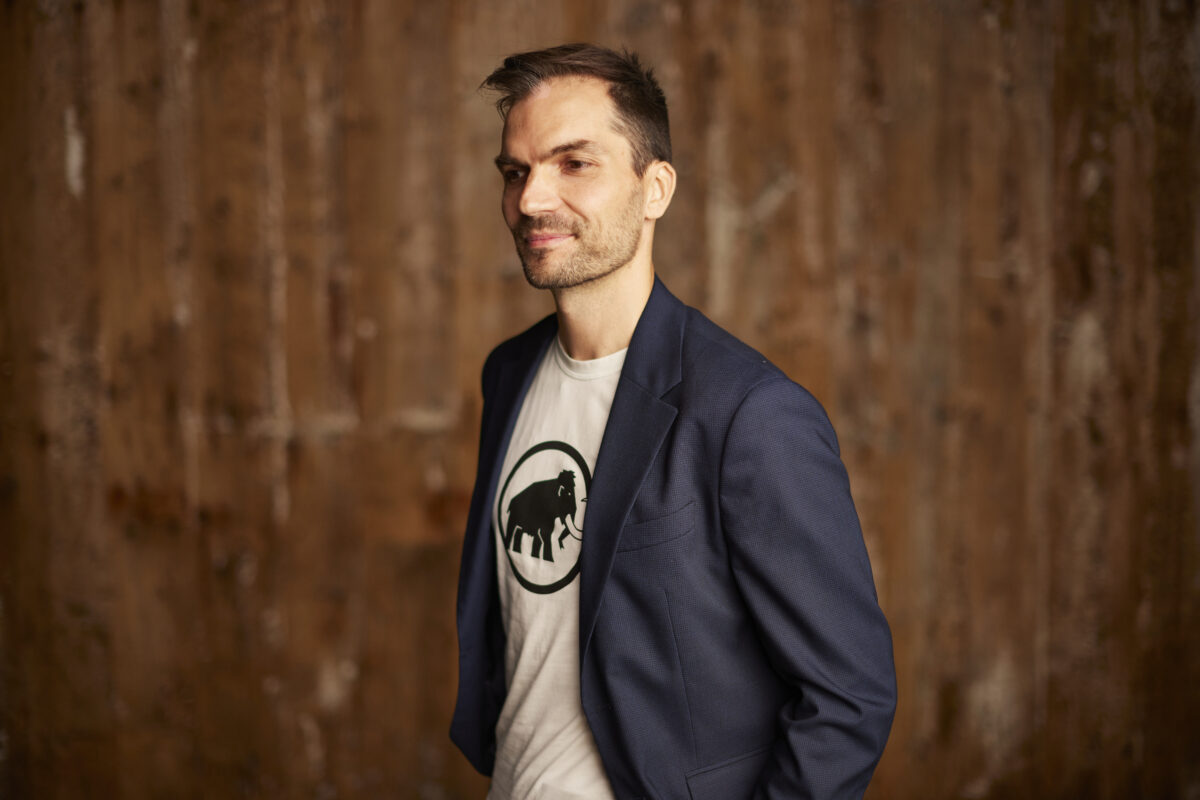
Jurij Ličen: You did some interesting studies, I think for the Venice Biennale, looking at the geology of different cities and how that geology determines building possibilities. One interesting example you gave was Manhattan, where the height and clustering of skyscrapers are directly dependent on the underlying geology – the bedrock and its depth.
Alper Derinboğaz: Exactly. New York is a striking example because it’s arguably the most man-made city in the world, yet it’s still fundamentally a translation of what exists underneath. The entire island is a continuation of a larger geological formation that was possibly adjacent to the Indian Plate many years ago. Understanding these details might allow future architects to work more intelligently with site conditions, potentially using technologies like 3D printing with earth or developing more sophisticated excavation and construction techniques. Today’s construction technologies are quite rigid, but I hope future technologies will bring more flexibility that helps us relate better to our surroundings and environment.
Jurij Ličen: Because you mentioned 3D printing as a digital fabrication tool, I think there was an interesting project you had in China, for the Learning Sky Library. Is that correct?
Alper Derinboğaz: It’s in Korea, in a new city called Songdo. The least popular New City. That’s the fate of new cities – they emerge over time. When you try to create a new city through a massive real estate project, it struggles for a long time.
Jurij Ličen: Before it’s really inhabited and appropriated by people?
Alper Derinboğaz: Yes, before it’s inhabited. I think it needs to fail because we project things we may not be capable of truly projecting, and those things have a hard time being realized.
Jurij Ličen: When you do things from a top-down approach, things often don’t happen as you would expect. In our office, we look at more naturally grown formations, like favelas or medieval cities with street patterns that emerged from necessity and organic logic, rather than planned design. Cities like Venice have beautiful, organic street patterns that we enjoy walking through, but we don’t know how to replicate that top-down approach anymore.
Alper Derinboğaz: Yes, as a practice, Salon is very interested in finding bases beyond human understanding using digital agencies. We try to augment our understanding or formal interpretations of what happens in cities and nature. In the case of the Korea library, regarding 3D printing, I’m not sure how long it will take to transform the construction industry. But we were trying to create a new concept of a library. If you look at the new generation, they don’t read as much. Books are important, but there are equally important ways of consuming information. We thought that if a library is the epicenter of information, then physical knowledge-generating systems are crucial. We hoped that 3D printing and maker culture would become an important part of future libraries.
“The beauty of digital production is that multiple people can work on the same project simultaneously because they can predict what will collide or work. I believe this should be the future of construction.”
– Alper Derinboğaz
Jurij Ličen: Because in the Seoul Sky Library project, you would print parts of the walls in a way that would engage people during construction, making the building process itself an exciting, visible artifact, rather than something hidden behind barriers.
Alper Derinboğaz: Buildings and construction processes should become part of city life. Some construction projects take five, ten, or even more years, which might represent an entire experience for someone briefly living in the city. We could develop better approaches to plan construction so it happens in continuation with the cityscape.
Jurij Ličen: This relates to your approach of “geo spaces”, where the long construction process of a building mimics a geological process – something we don’t remember when it started, and which has its own logic. Was this intentional for the Istanbul Museum project, or did it emerge naturally?
Alper Derinboğaz: You always plan to finish as soon as possible, which never happens, especially with complex large-scale projects involving public decision-making. This is a 40,000 square meter museum, one of the largest in Istanbul, using complex construction technologies. It was not planned to take this long, but these things become part of the city, the practice, and society. Buildings take years to build, stay for many years, survive transformations, and potentially come back to life. Architectural time is an important tool to comprehend Earth’s existence. As humans, we struggle to understand how tiny our existence is compared to the Earth’s timeline. Through architectural time, we can relate to things beyond our lifetime. We must consider whether we need buildings that survive for generations or if we should develop more flexible approaches.
Jurij Ličen: Let’s talk about one of your first built works, the Augmented Structures facade project. You were trying to map street sounds onto a facade, transforming sounds into a three-dimensional sculpted space. I understand that the contractor was unwilling to build it, and you had to figure out how to do it yourselves. How did that story unfold?
Alper Derinboğaz: It’s a funny story about how you become a contractor. This was our first built project in 2011, collaborating with Refik Anadol. It was a very early time for digital fabrication at this scale, especially for a practice just out of school. We were experimenting with three or four different materials and complex tectonics in the same surface.
Jurij Ličen: This was around the early years of Rhino and Grasshopper?
Alper Derinboğaz: We were working on the manuscript before Grasshopper existed. We would design things and they would fail. We realized that codes don’t always work perfectly without problems. It was an exciting time in Istanbul, which was culturally booming. We saw the cityscape as a superficial representation that undermined the city’s qualities. The street we were building on was the most popular square, but beyond architectural formation, the acoustic formation truly signified the place. We wanted to capture its essence by doing acoustic analysis and translating sound recordings into three-dimensional architectural interpretations. With motivation and luck, we finally executed it in reality.
Jurij Ličen: So you needed a perfectly precise match between the digital model and the built structure to project the visual performance correctly?
Alper Derinboğaz: Exactly. Refik would typically scan the building and work on the project for three months to create a video technique. In this case, we had only two to three months for both construction and visual preparation. We were working in parallel, almost like a marriage. The beauty of digital production is that multiple people can work on the same project simultaneously because they can predict what will collide or work. I believe this should be the future of construction.
What I’ve found as a guiding principle is to follow intuition. Despite being an academician involved in academic writing and research, I believe most discussions remain very surface-level. Our intuitions can go much further. Following your curiosity is extremely important.
– Alper Derinboğaz
Jurij Ličen: As a closing question, given your global practice and experience working across different scales and cultures, what are the key characteristics that make a good architect or designer? What do you look for in collaborators?
Alper Derinboğaz: Perhaps as advice to the younger generation – though advice rarely works – what I’ve found as a guiding principle is to follow intuition. Despite being an academician involved in academic writing and research, I believe most discussions remain very surface-level. Our intuitions can go much further. Following your curiosity is extremely important. In the worst-case scenario, you’ll at least enjoy what you’re doing. If things don’t work out, you’ll learn something new and develop different ideas. If things do work, you might create something inventive and groundbreaking.
Jurij Ličen: I think curiosity is a key word here. I’ve heard from others that if you want to be successful as a designer or architect, you need to be curious first and foremost. If you’re passionate about something, you’ll find your way. Thank you very much for this conversation.
Alper Derinboğaz: Thank you. It was great meeting you. Amazing set of questions.
Video and portraits by
Primož Korošec
Powered by