


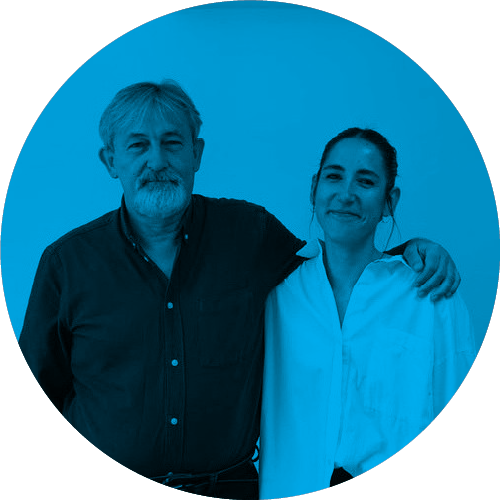
Zijo Krvavac and Dunja Krvavac
I.D.E..A. Sarajevo, Bosnia and Herzegovina
Zijo Krvavac (1960) is an architect, founder and director of the architectural firm I.D.E..A. Sarajevo.After completing his studies at the Secondary School of Civil Engineering and Geodesy in Sarajevo (1975-1979), he enrolled at the Faculty of Architecture at the University of Sarajevo. Upon graduating in 1985, he earned the title of graduate engineer of architecture.Zijo’s career began at the architectural firm Arhitekt in 1986, where, as a young architect and later as the lead architect, he had the opportunity to contribute to a wide range of projects, particularly public ones. During his time at Arhitekt, he collaborated with some of the most respected names in Bosnian-Herzegovinian architecture, such as Ivan Štraus, Mladen Gvozden, and Dragan Bijedić, on projects that helped shape Sarajevo’s urban landscape at the time.It was also during this period that Zijo began participating in architectural competitions, which he considers a vital part of a healthy and professional architectural practice. Over his career, he has participated in more than 50 public competitions. Notable successes include: Urban Design of the City Center in Doboj (1989, Second Prize: Zijo Krvavac, Mladen Gvozden, Dejan Tadić, Dragan Toprek), Office Building of Atlanska Plovidba in Dubrovnik(1990, Third Prize: Zijo Krvavac, Mladen Gvozden, Goran Rakočević, Milan Malinović), Business Center Novo Sarajevo (1991, Second Prize: Zijo Krvavac, Mladen Gvozden, Goran Rakočević, Milan Malinović), Hospital in Goražde (1997, First Prize: Zijo Krvavac, Sakib Oković, Aida Subašić, Dragan Bijedić), and Dobrinja Public High School in Sarajevo (1999, First Prize: Zijo Krvavac, Sakib Oković, Mirela Imširija, Ardina Pondro).Some of the significant team projects from his time at Arhitekt include: Papagajka (1986), Retirement Home in Nedžarići (1991), Parliament Building of Bosnia and Herzegovina(1997-1999, Restoration), Elektroprivreda in Sarajevo (1998-1999, Restoration), Jewish Cemetery Chapel in Sarajevo(2000, Restoration), Hospital in Goražde (2000), Dobrinja Public High School (2000), and Water Management Office Building (2001).Zijo continued to work at Arhitekt during the war and until 2001, when he met colleagues and friends Sakib Oković and Dejan Tadić, with whom he co-founded the architectural firm I.D.E..A. in 2002.I.D.E..A. has successfully operated for 23 years, working on numerous public and private projects, including: Dubrovnik Cinema-Cinema City in Sarajevo (2002), European Development Bank Headquarters in Sarajevo (2002), Media Center in Sarajevo (2002), White Hall in the Parliamentary Assembly of Bosnia and Herzegovina (2006), Great Hall in the Parliamentary Assembly of Bosnia and Herzegovina (2006), Mojmilo Urban Forest (2006), Memorial Room at the Potočari-Srebrenica Memorial Center (2007, collaboration with OSNAP), Parliamentary Assembly of Bosnia and Herzegovina(2007, Facade Reconstruction), Federation of Bosnia and Herzegovina Parliament (2008), Otoka Football Stadium (2009-2011), Sports Hall in Umihana Čuvidina Primary School(2015-2017), Zabrđe Islamic Center (2015), St. Francis of Assisi Church in Dobrinja(2016, collaboration with Ivan Štraus), Bosnia and Herzegovina Urban Public Square (Stone Square) (2017-2018, Restoration), Susan Sontag Urban Public Square in Sarajevo (2016-2017), Safet Zajko Sports, Education, and Recreation Center in Sarajevo (2017), Clinical Center of the University of Sarajevo (2010-2017), and ASA Hospital (2022-2024), along with many other public and private projects.Zijo’s participation in competitions remains steadfast. He has taken part in competitions for: BBI Center (2004, Special Recognition: Zijo Krvavac, Sakib Oković, Dejan Tadić), Federation of Bosnia and Herzegovina Government Building in Mostar (2008, Second Prize: Zijo Krvavac, Sakib Oković, Dejan Tadić, Alma Karamehmedović, Sanja Ibradžić), Sarajevo Canton Development Planning Institute Building (2012, Second Prize: Zijo Krvavac, Aida Halilagić, Nataša Tabori, Edin Jenčiragić), Memorial for the Killed Children of Sarajevo 1992-1995 (2007, Zijo Krvavac, Sakib Oković, Dejan Tadić), and first place in the competition for the urban-architectural design of the Congress Center in Novo Sarajevo (2014, First Prize: Zijo Krvavac, Sakib Oković, Dejan Tadić, Vedad Orahovac, Sanja Ibradžić).From 2012-2013, he was the director of the Sarajevo Canton Development Planning Institute and, from 2014 to 2016, he was the president of the Association of Architects of Bosnia and Herzegovina. He was a member of the Mayor’s Advisory Council for Urban Planning in Sarajevo on two occasions (2009-2011 and 2013-2014). Zijo also served as a jury member for several public competitions, including: Žuč Memorial Center (2015), Dobrinja-Butmir Tunnel(2016) and Kazani Memorial in Sarajevo (2021).Zijo Krvavac currently lives in Sarajevo and works together with his daughter
Dunja Krvavac who is also an architect. Dunja Krvavac was born in Sarajevo where she attained primary and secondary education as an International Baccalaureate student. She enrolled at the Faculty of Architecture at University of Sarajevo in 2011 and finished her Bachelor’s degree in 2017, focusing on architectural design and constructive systems. In 2017, she started her Masters at the same faculty where she’s currently finishing her thesis on optimisation of housing and social infrastructure. migrations. In 2018, she spent one semester at the Norwegian University of Science and Technology in Trondheim, Norway, focusing her studies on urban planning and design. While studying, she’s been part of LIFT – spatial initiatives, a non-profit non-governmental organisation that aims to educate local communities on architecture, urbanism and design, where she worked as project manager of LIFT’s biggest project which is biennial festival Days of architecture Sarajevo. In 2021 she teamed up with Nikola Ostojić on various projects such are: KB.apt (Collegium Artisticum 2021: Selection), AS13 (Collegium Artisticum 2022: Selection) and Manifesto gallery of contemporary arts in Sarajevo (2022). In 2021, she partnered up with Jasmin and Ilma Sirčo from Sinteza architecture studio on project MST923: Kazani and in 2022 the project was awarded with Collegium Artisticum 2022. She worked on Urban Lab Sarajevo, a collaborative project with UNDP BiH, Municipality Centar Sarajevo and Faculty of Sarajevo that focused on producing a digital platform for inclusive consultations for several public spaces in Sarajevo. Her lecture titled Public Space? in Sarajevo 1945-1992 was part of KUMA International Summer School: Between Past and Future held in August 2022 and KUMA International collaborative project with Syracuse University and Yale University in March 2024. She continued exploring the topic of Sarajevo public spaces along with architect and colleague Irhana Šehović through joint LIFT and LINA European architecture platform projects: (UN)CONTEXT_Dissecting the layers: Sarajevo residency workshop and exhibition (2023), SPACE OF BECOMING movie that explores space and movement done in collaboration with Rebeka Bratož Gornik and Daniel Proietto (2024) and MAXXI ARCHITECTURE FILM LAB IN COLLABORATION WITH LIFT producing 5 short movies themed around MAXXI’s Stop Drawing exhibition curated by Pippo Ciorra (2025). She co-authored 3650 DAYS OF CONTEMPORARY ARCHITECTURE IN SARAJEVO (2018) and Architectural Guide Sarajevo published by DOM Publishers (Berlin) (2023). She illustrated architectural illustrations for the book Urban Rooms of Sarajevo by authors and colleagues Nermina Zagora and Dina Šamić (2021).In 2023, together with friends and colleagues Irhana Šehović and Nikola Ostojić, she co-founded ARRA Collective – ARhitektonska RAdiona a not-for-profit research and design collective based in Sarajevo, dedicated to exploring speculative, experimental and critical approaches to urban practices aiming to challenge how architecture and urbanism are perceived, understood and practiced by connecting local contexts with global practices.
BIG SEE Perspectives Nominations


2025: Faris Jašarević 2026: Marko Vlaisavljević