


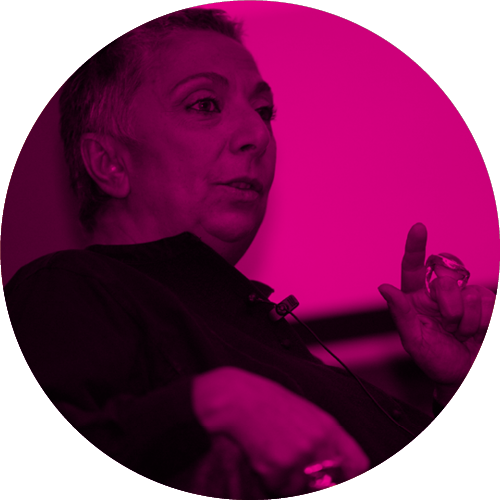
Paola Navone
Italy
Authentic, dreamy, eclectic: in her soul coexist the vibrancy and colors of the familiar, beloved, and often-visited South, combined with the taste and forms of the open, fluid, tradition-rich West. From all of this arises her inexhaustible curiosity in searching for materials, forms, and structures — in the present, the past, and the future.
After completing her studies in 1973, Paola Navone worked as art director (1975–79) at CentroKappa: designing and developing corporate identity, sales tools, points of sale, exhibitions, and special initiatives. During this period, she collaborated with Alessandro Mendini for the magazine MODO. In 1979 she encountered the company Abet — with whom she still collaborates — and its laminates, discovering her passion for designing hard surfaces. Alongside her research for Centro Studi Domus on “Industry and Decor,” she also began collaborating with Sottsass, Branzi, and Guerriero. The company Knoll International asked her to design a furniture program for them.
Between 1982 and 1984 she designed products for Alessi, became a consultant for Abet Laminati, and collaborated on Guida Jannone’s research project on innovation with the Marketing Advance group at Renault. She taught at the Faculty of Architecture in Reggio Calabria (industrial decor) and Florence (surface design), and in 1984 held a series of lectures on design trends for fashion stylists at C.P.F. in Modena. She also worked with Società Immagine Industriale on product development in the textile, ceramic, and furniture industries. With Daniel Rozensztroch she collaborated on the project “Escape Center,” and the following year worked on “developing electronic signage” with Guido Jannon and Franco Raggi.
Between 1985 and 1988 a turning point occurred in her creative approach: she became a consultant for the World Bank and UNIDO for image and product design in the Philippines, Indonesia, Malaysia, and Thailand. As part of these activities, she prepared exhibitions, symposia, and conferences.
In 1988 she founded Mondo together with Giulio Cappellini. From 1988 to 1998 her work flourished with numerous initiatives in design, interior design, and planning, culminating in her entry into the world of fashion: for Piazza Sempione — just as she had previously done for Mondo — she developed the brand concept, retail spaces, and showroom in Milan (and showrooms in Rome, Düsseldorf, and Tokyo).
From 1995 to 1999 she designed retail and exhibition concepts for Driade, the Otto line for Gervasoni, the Andaman, Cyclades, and Hebrides beds for Orizzonti, the Lune and Grass lines for Arcade, ethnic furniture for Oltrefrontiero, furniture and accessories for Casamilano, and designed the jewelry store of Piero Milano.
From 2000 onwards, her wide circle of clients grew to include Antonangeli (lighting and porcelain/stone objects), Molteni (sofas, armchairs, beds), and Natuzzi (two armchair lines). For Roche Bobois she designed the Ping Pong line, for Swarovski the Morgana candleholder, and objects, chairs, and accessories for Egizia, Lando, Bab AnMil, Riechembach, and Baxter. In April 2005 she presented the “Pastasciutta” kitchen for Ciatti, lights for Italamp, and Illy Bar Concept — five bar typologies for city and suburban areas. In 2006 more new projects followed for Poliform, Ceramica Vivo, Idealform, Lando, and Falper.
In Paris, Salvati’s new jewelry store was recently opened — the first of a planned forty retail locations — and in the United States seven new Piazza Sempione stores are being completed.
Paola Navone does not want to design systematically; instead, she wants to remain just a little more curious than others (as stated in the justification for the International Design Award she received in Osaka in 1983). She wants to be a citizen of the world — to observe and to discover.